Buddhist Priests Supporting Entrepreneurial NPOs
An Interview with Rev. Tsuruno Koyu, Co-founder
Beyond COVID-19 Series: Interview #53
Bunka Jiho newspaper Friday 10 October 2025
Article by Sakamoto Yuri
Translated and edited by Jonathan S. Watts
The new electricity company Tera Energy Co., Ltd. was founded in 2018 by four Buddhist priests in Kyoto City with Rev. Takemoto Ryogo serving as president. These priests were initially involved in suicide prevention with Sotto: the Kyoto Suicide Prevention Centre in Kyoto. Having seen the suicide issue as the tip of the iceberg of a myriad of social issues that have emerged with the downturn in Japan’s economy since the 1990s, these priests decided to work on a more holistic response.[1] We spoke to Tera Energy’s director, Rev. Tsuruno Koyu 霍野廣由 (38), a founding member and head of their new disaster prevention division, about their activities for “illuminating” society.

Sacrificing Profits to Gain Donations
Rev. Tsuruno noted, “After finishing graduate school, I joined an NPO where we struggled with fundraising. Looking around, I saw many charitable organisations facing the same problem. To solve these financial issues, we launched this business, Tera Energy.”
Q: But why electricity?
A: Our team was exploring ways to create a system where funds would flow to Buddhist temples nationwide engaged in social work with non-profit organizations (NPO). During this period, Rev. Takemoto learned of an example in Germany where ordinary citizens had established an electric power company and were returning a portion of the profits to the community. This was around the time of the liberalisation of the Japanese electricity industry began[2], and he thought, “This is what I’ve been looking for.”[3]
Q: As a Buddhist priest starting a business, and specifically an electricity company, did you face criticism?
A: The media reported, “Priests from the Jodo Shin sect have founded an electricity company”, and footage of our head temple, the Nishi Hongan-ji, was shown. Nishi Hongan-ji received complaints from parishioners nationwide, which caused them troubles. However, we explained our intentions and gained their understanding.
Q: It’s been seven years since the launch. How has it gone?
A: There were several precarious moments. The electricity market became turbulent, and the more we sold, the deeper came the losses. At such times, various temples came to our aid. It is precisely because of this support that we are still operating today.
Q: I understand a portion of your profits is then donated?
A: Among roughly 700 competitors, we rank around 70th in sales, placing us within the top 10%. People often assume the donation amount is added to electricity bills, but that’s not the case. We are actually cutting into our profits to make these donations. We go to such lengths, because we understand the strain of sustaining social initiatives. Rather than monopolising profits, we remain committed to the founding principle that, “Happiness and prosperity lie in sharing”.
Q: This solid philosophy and narrative form Tera Energy’s strength, don’t you think?
A: I believe so. With electricity liberalisation, users switch providers as easily as they change mobile phone contracts when cheaper new services emerge. However, those who sign up because they resonate with our values rarely leave. Our customer turnover rate is significantly lower than competitors’ precisely because they value aspects beyond price.
Fire Service Collaboration and Disaster Prevention Events
In 2023, aiming to accelerate decarbonisation, Tera Energy concluded a cooperation agreement with Kyoto City. By 2025, they were selected as a partner organisation for the Kyoto City Fire Department.
Q: In your sales activities, what kind of response have you received from temples?
A: While terms like “climate change” and “decarbonization” don’t particularly capture temples’ interest, mentioning their potential as disaster-preparedness hubs for the community gets a positive response. Some temples involved in disaster relief efforts, such as after the Great East Japan Earthquake of 2011, have installed solar panels and storage batteries, because they want to be there for their community in times of need. We’re gradually connecting with temples that share this mindset.
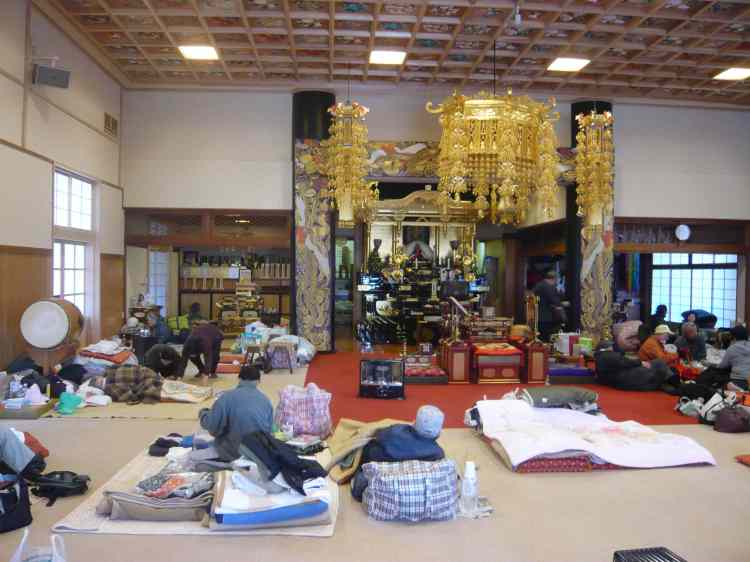
Q: Temples serve as local hubs during disasters, providing shelters and communal meals. So you all felt it was novel for temples to be involved from the awareness-raising stage before disasters occur?
A: I heard that Myofuku-ji Temple 妙福寺 of the Honmon Butsuri sect of the Nichiren and Lotus Sutra tradition, which supports Tera Energy, had signed a formal agreement with Fushimi Ward in Kyoto to serve as a designated evacuation site during disasters. However, we were concerned about how well this was recognised locally and whether it could truly function as an evacuation centre when disaster struck. During a conversation with their abbot, Rev. Matsumoto Genkun 松本現薫, the idea arose to hold events at the temple to help people understand that, “This temple is actively involved in disaster preparedness, so please evacuate here if needed.”
In September this year, we held a disaster prevention event at Mibu-dera Temple 壬生寺—the head temple of the ancient Ritsu sect based on the practice of the bhikkhu vinaya—in collaboration with the City Fire Department in Kyoto. It was well received by local residents, who requested we hold it again next year, and other temples also expressed interest. Having gained the know-how, we believe we can now offer this service. That said, organising events incurs costs. We intend to seek sponsors to ensure the project’s continuity.
Q: I understand you are assisting the City Fire Department in promoting and raising awareness of their seismic-sensitive circuit breaker initiative. What exactly is a seismic-sensitive circuit breaker?
A: It is equipment that automatically trips the circuit breaker and cuts the power when it detects a major earthquake of seismic intensity 5 or higher. In discussions with the fire department, I heard their concern that although it’s a good device, it isn’t widely recognised. Installing it in temples, which often have many wooden structures, would be extremely helpful. Furthermore, many of Tera Energy’s customers are very interested in social issues. That’s why we decided to assist with its promotion and awareness. The manufacturer also passionately explained that installing it in shrines and temples holds significant social value. We plan to visit soon the Fujisan Hongu Sengen Taisha Shinto shrine in Shizuoka Prefecture, which already has it installed, for an inspection.”
The Company is the Means; the Purpose is Support
Q: How do you envision expanding support for charitable organisations going forward?
A: We currently donate to around 150 organisations. While our focus has been on connecting with various groups, our new approach will involve deeper communication with these established connections, promoting Tera Energy to both the organisations and their supporters. However, we are not primarily interested in selling electricity. We use the donation-linked electricity scheme solely as a means to support non-profit organizations (NPOs) and NGOs. We are currently renewing our website and aim to create a platform, similar to crowdfunding, where NPOs and supporters can connect.
Q: So your company’s goal is what, precisely?
A: We will generate solid electricity sales revenue to fund donations. However, our primary measure of success will be “how much we donate”, not “how much we sell”. We aim to reach ¥100 million ($640,000) in donations.
Profile: Rev. Tsuruno Koyu was born in 1987 in Kaku-enji temple of the Jodo Shin-shu Honganji denomination in the town of Kamo in Fukuoka Prefecture in southern Japan, where he presently serves as the vice-abbot. After graduating from the Ryukoku University Graduate School of Practical Shin Buddhist Studies, he joined the certified NPO Sotto: the Kyoto Suicide Prevention Centre, where he currently serves as a director. He is also a part-time lecturer at So-ai University and a member of the Jodo Shin-shu Hongan-ji denomination Children and Youth Connection Promotion Committee. This year, he presided over the “International Expo Temple” 万博寺 event at the Osaka-Kansai Expo, which brought together priests from various sects.
[1] The original article included this sentence in the introduction: “With an eye on the future a thousand years hence, it [Tera Energy] focuses on disaster prevention to foster a spiritually rich, secure, and safe way of life.” As noted later in the interview, disaster prevention is a popular topic among Buddhist temples in Japan. Thus, the publisher seems to have wanted to attract the attention of readers through this sentence, which is a rather limited way of depicting Tera Energy’s mission. The translator has augmented this introduction by connecting Tera Energy’s original mission to suicide prevention.
[2] Liberalization of Japan’s electricity industry began in stages, starting with wholesale market opening for Independent Power Producers (IPPs) in 1995, followed by retail deregulation for large industrial users in 2000, then expanding to medium-sized businesses by 2005, and culminating in the full liberalization for all consumers (including homes) in April 2016.
[3] Such a mechanism had already been created in Japan by another Buddhist priest named Rev. Okochi Hidehito in Tokyo around 1999. During the establishment of Tera Energy, Rev. Takemoto was introduced to and visited Rev. Okochi’s temple. The two are now both members of INEB’s international Eco-Temple Network.
 JNEB
JNEB 