Citing evacuation plans for nuclear power plants that have failed & how the Noto Peninsula Earthquake proves an irresponsibility towards life
Bukkyo Times May 16, 2024
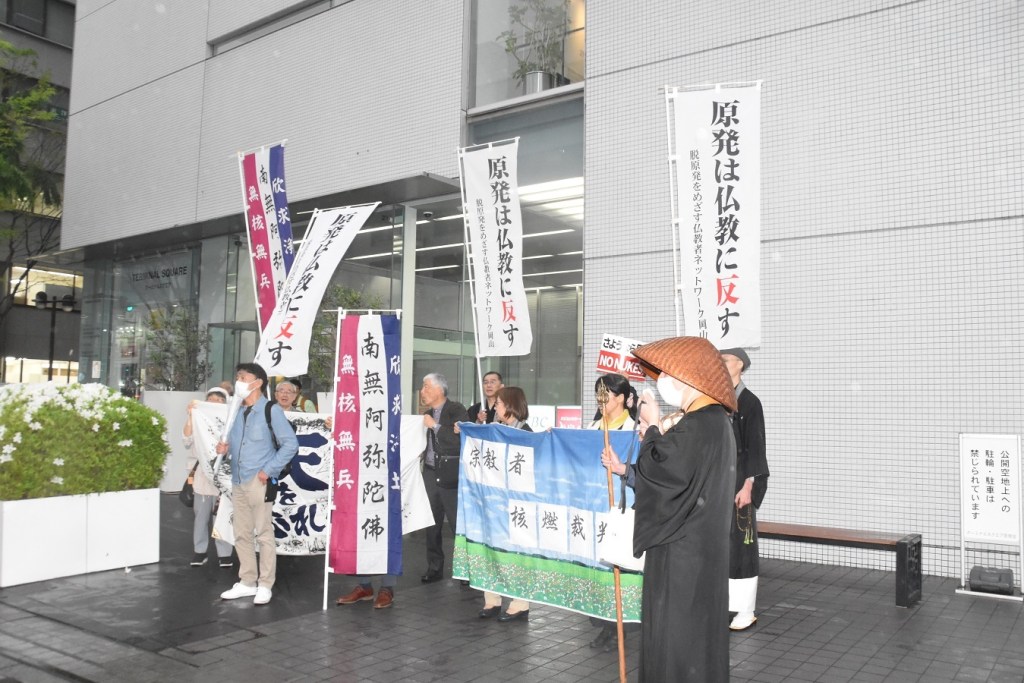
On April 24, the plaintiffs of the “Religious Nuclear Fuel Tribunal” [created by the Interfaith Forum for the Review of National Nuclear Policy] seeking an injunction against the operation of nuclear facilities (including a reprocessing plant) in Rokkasho Village, Aomori Prefecture, held the “National Caravan for Nuclear Power Free Japan in Okayama” at Inryoji Temple of the Rinzai Zen Myoshin-ji sect in Kita-ku, Okayama City, located in southern Japan. Rev. Hiroaki Osada (the abbot of Hoten-ji, a Jodo Shin Pure Land temple in Hyogo Prefecture near Kyoto) is a native of Okunoto, the northern tip of the Noto peninsula which experience a major earthquake on New Year’s Day of this year. He reported on the history of the anti-nuclear movement in Suzu City, the main city of Okunoto, and the damage caused by the Noto Peninsula earthquake. He pointed out the sloppiness of the evacuation plan and declared, “It became clear that the existence of nuclear power plants in an earthquake-prone country is nothing more than the abandonment of the local residents.
Rev. Osada, who has been in the affected areas since immediately after the earthquake, commented on the lack of progress in restoration, “There is a complete lack of manpower in the Noto Peninsula. The governor must ask for help now. I have never seen so few people active at the site of such a disaster. If you are going to travel to Noto, even for just one day, please come and lend a hand.”
In 1989, plans for 10 nuclear reactors we made in the vicinity city of Suzu, and the proposed sites ended up being located near the epicenter of the earthquakes in May of last year and the one on New Year’s. The anti-nuclear movement, in which Rev. Osada participated at that time, started with 10 people and later spread, dividing the town into proponents and opponents. In 2003, the plans were scrapped, but he said, the issue “left a big scar on my relatives, friends, and all my relationships. And this time, everyone became a victim. People who lost their homes and fled to evacuation centers laughed and said they were glad that the Suzu nuclear power plants had not been built. I felt a little hope that the earthquake might help us overcome the deep rift between us.”
Fortunately, the Shika Nuclear Power Plant, located on the southwest coast of Noto 80 kmsa from Suzu City, was spared an emergency situation as it had not operation since the Fukushima disaster of March 11, 2011. Still, the earthquake exposed the inability to evacuate residents with roads cut off by the damage. Rev. Osada said, “All evacuation plans have failed. It became clear that the existence of nuclear power plants in an earthquake-prone country is nothing more than the abandonment of the local residents. He raged against the “irresponsibility for the lives of the local residents” by the courts, the government, and scientists involved in promoting nuclear power. He asked the audience to “imagine what would have happened if several nuclear power plants had stood side by side in this area” and appealed to them to “remember that the people of Suzu has successfully stopped such construction and the eventual damage caused by radiation, which robs people of their livelihoods.
Plaintiff co-leaders of the Interfaith Forum–Rev. Tetsuen Nakajima (abbot of Myotsu-ji, a Shingon temple in Obama City, Fukui Prefecture) and Rev. Shingo Naito (Toshidai Church in Matsudo City, Chiba Prefecture of the Evangelical Lutheran Church of Japan) gave an overview of the ongoing nuclear fuel trial. Rev. Nakajima criticized the discriminatory structure of nuclear power plants for the consumption of large amounts of electricity in urban areas, while their locations are pushed into depopulated, rural areas. He stressed the significance of the campaign to stop nuclear power plants as an important role for the generations to come. Rev. Naito explained the Higuchi Theory, which calls for an injunction against the operation of reprocessing plants on the grounds that they are more dangerous than nuclear power plants and have extremely weak earthquake resistance standards. Referring to the relationship between the nuclear fuel cycle business and the development of nuclear weapons, he stressed that shutting down the reprocessing plant in Rokkasho in Aomori, which is the foundation of the nuclear power administration, would “stop all nuclear power plants in Japan”.
After exchanging opinions with the participants, they carried banners and marched from the venue to Okayama Station to appeal for a nuclear power free world.
 JNEB
JNEB 