Toward a Buddhist Community That Does Not Remain Silent
Ven. Tsuyu no Gokuraku
Rakugo Storyteller and Tendai Buddhist Nun
Bukkyo Times January 29, 2026 #3110
In recent years, we have had more opportunities to see and hear the term “gender.” However, its meaning has yet to fully permeate society, including the Buddhist community. It seems that quite a few people [in Japan] misunderstand it as a political buzzword or an extreme ideology
However, just as “gender equality” is listed as the 5th goal of the SDGs (Sustainable Development Goals), this is by no means a political or ideological issue. It is an issue that humanity must confront in order to build a sustainable future.
So, what exactly is “gender”? Unlike “biological sex”, it refers to “socially and culturally constructed gender”—in other words, “masculinity” and “femininity.” As such, “gender equality” means creating a society where people are not constrained by “masculinity and femininity,” but rather where we focus on “being true to oneself,” allowing everyone to demonstrate their abilities without being bound by gender. However, even in this day and age, “gender-based division of roles” still persists within the Buddhist community [in Japan].
Women Quietly Leaving the Temples
Just the other day, a middle-aged woman shared her concern with me: “At my family temple, women are still in charge of serving tea.” It’s not that women dislike serving tea. They are simply frustrated and exhausted at the outdated temple society. I once mentioned this kind of incident during a training session for monks and nuns, and the response I received was, “At my temple, women are also in charge of serving tea, but I’ve never heard such an opinion.” However, many parishioners believe that, “It would be unthinkable to voice an opinion to the temple” and therefore, keep their thoughts to themselves. That is precisely why it is crucial—to prevent people from drifting away from temples—not to assume lightly that “since no such opinions have been raised, everything is fine,” but rather to maintain a sense of urgency and make updates in line with the times. Those who harbor doubts eventually give up even on voicing their opinions and quietly distance themselves from the temple.
Society Takes a Hard Line on Silence Regarding Sexual Abuse
Furthermore, the “sexual abuse” scandals frequently reported within the Buddhist community are accelerating this trend of people drifting away from temples. The fact that monks—who are socially regarded as “holy”—commit sexual abuse is in itself a major shock to the public, but society is also casting a harsh eye on the Buddhist community for its “silence” regarding these issues. So why does abuse occur, and why is there silence?
I believe one cause lies in the “opacity” and “closed nature” of the religious community. In religious settings, people often seek one-on-one counseling for personal struggles or internal family issues. However, in cases I have handled in the past, there have been instances where the person seeking counseling was unilaterally pursued by the religious figure they were consulting with—being hugged or even stalked.
The religious community by its very nature is closed. In such an environment, when someone from such a community develops thoughts that deviate from ethical and social norms, the mechanisms to correct those thoughts often become weak. That is precisely why it is necessary not only to “discipline the perpetrator and call it a day,” but also to devise systems to prevent such abuse from occurring in the first place.
Furthermore, I must say that “self-preservation” lies behind the silence of many monks regarding sexual abuse issues. The Buddhist community is characterized not only by master-disciple relationships but also by “close-knit” ties that connect to blood relations and dharma lineage. I feel that for many monks, these ties have become “shackles” that prevent them from taking action. However, these “shackles” are ultimately just our excuses; in the wider world, they are called “self-preservation.” I want them to realize as soon as possible that this self-preservation is causing the Buddhist community to lose the public’s trust.
Why Can’t We Be More Proactive on Gender Issues?
Recently, there has been an increase in temple events themed around the SDGs, but most of them address issues of poverty or the environment, with very few focusing on gender equality. However, this is not limited to the Buddhist community; the media is the same. Even on TV programs covering the SDGs, gender issues are rarely addressed. This is likely influenced by a “reluctance toward gender equality” on the part of organizers and program producers. This is because gender is an issue that applies to everyone. Precisely because it is the most immediate human rights issue, unconscious “self-interest”—such as wondering, “If men and women truly become equal, what will happen to the roles we’ve traditionally relied on women to fulfill?”—tends to come into play. Even in human rights training sessions for religious leaders, while opportunities to learn about sexual minorities have increased, gender equality is surprisingly rarely addressed. While it is very important to hear the voices of sexual minorities themselves, is it not also a necessary mindset for the Buddhist community—which preaches “right view”—to not avert our eyes from the issue of “gender equality,” an issue in which we are already “directly involved”?
The Chinese character for “sex” (性) is made up of two characters meaning “the mind-heart 心 that is living 生”. Let us make the Buddhist community one that does not remain silent, so that no one is hurt by issues of “sex”!
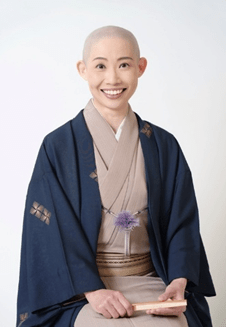
Rev. Tsuyu no Gokuraku was born in 1986 in the shadow of Mt. Fuji in Shizuoka Prefecture. Her interest in religion stemmed from a fear of death she had since childhood. In her first year of high school, she encountered the Lotus Sutra and resolved to become a Buddhist priest and a rakugo performer—a traditional Japanese form of storytelling with comic themes. In 2005, she began her training under in a lineage of rakugo performers started by a Buddhist priest and studied with the third-generation teacher Tsuyu–no–Gorō. In 2011, she took monastic vows in the Tendai sect and began her training at Mt. Hiei. In 2021, she founded the Doshin-ji Temple 道心寺 of the Tendai denomination in Amagasaki City, Hyogo Prefecture, aiming to create “a temple where everyone can find happiness”. As the head priest, she offers counseling sessions at the temple and is a Gender Equality Promotion Officer for Amagasaki City.
This article was translated and edited by Jonathan S. Watts and published here on the JNEB homepage with the permission of the Bukkyo Times.

